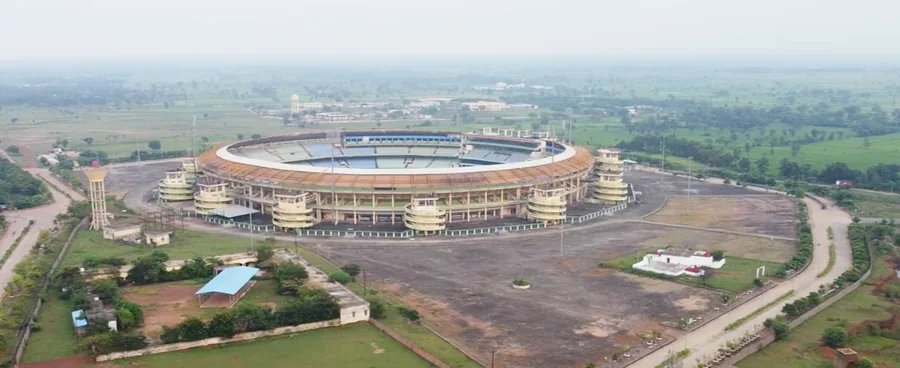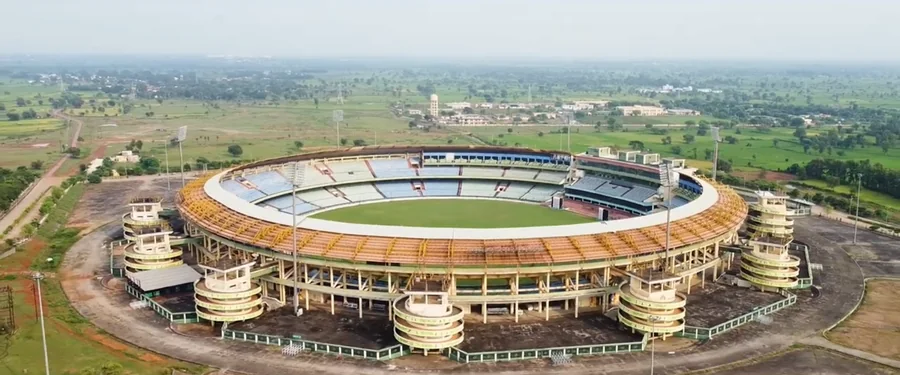
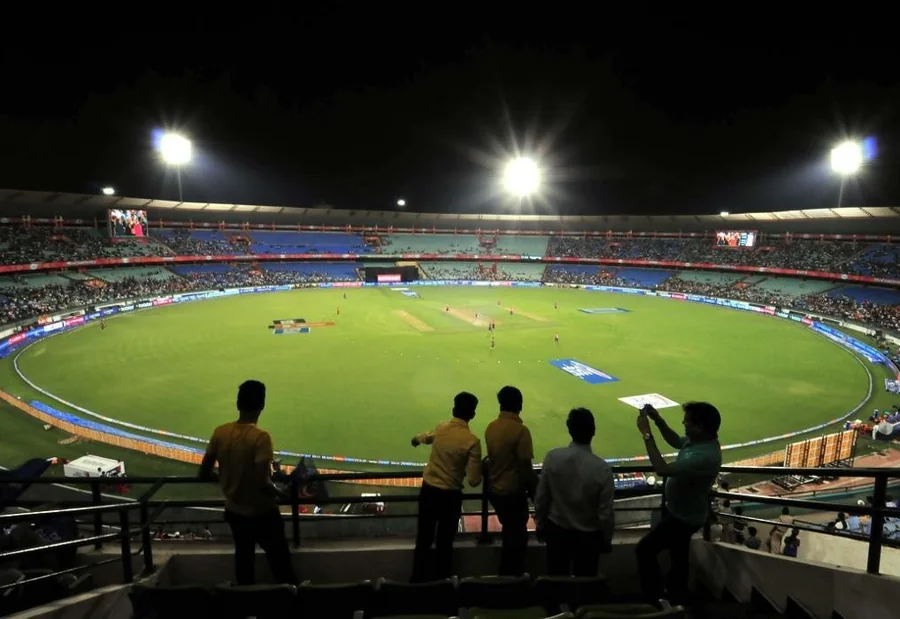

The India Women vs Zimbabwe Women 2nd T20I pitch report starts with an important contrast: Zimbabwe made 114/5 in Raipur on 16 October, yet India slipped to 19/4 before recovering to win by four wickets. Runs were available, but early wickets made the chase demanding. At Shaheed Veer Narayan Singh International Stadium, the first-match evidence offers more useful context than a blanket “batting paradise” or “bowling pitch” label.
This Shaheed Veer Narayan Singh Stadium pitch report for India Women vs Zimbabwe Women 2nd T20I separates the completed opener from the 18 October 2026 match, scheduled for 7 PM IST. Niki Prasad reported dew and a surface that slowed later in the opener; the same conditions, or the same playing strip, are not confirmed for the second game.
Shaheed Veer Narayan Singh Stadium Pitch Report at a Glance
India were 19/4 before Deepti Sharma’s 49 and Niki Prasad’s unbeaten 39 helped finish the chase. A low target did not make the early overs straightforward.
Zimbabwe scored 114/5 in 20 overs. One completed first innings cannot establish a reliable venue average or competitive-score range.
The four-wicket win came with 26 balls left, but one result does not establish a dependable Raipur chasing trend.
Niki Prasad described substantial dew in the first match. Check the selected pitch and actual moisture before assuming the second innings will be easier.
Raipur Pitch Batting or Bowling: What Did the Opener Show?
Verdict: Bowling control and patient rebuilding mattered, without proving a permanent bowling-friendly surface. Zimbabwe’s 114/5 and India’s early collapse show pressure; the successful recovery shows that batters could still score. One match cannot confirm the next strip’s pace, bounce or turn.
Early wickets changed the chase
- India fell to 19/4.
- Nyasha Gwanzura finished with 3/18 in three overs.
Wickets and bowling choices mattered. The collapse alone does not prove seam movement or a difficult pitch.
Set batters rebuilt the innings
- Deepti Sharma: 49 off 37 balls.
- Niki Prasad: 39 not out off 35 balls.
India recovered to 116/6 in 15.4 overs, showing the value of keeping the chase alive after a poor start.
Both bowling types took wickets
- Nandni Sharma: 2/11 in four overs.
- Spin and pace combined for all 11 wickets.
There were opportunities for different bowlers. Their figures must be read alongside workload and the batters they faced.
What the First-T20I Bowling Data Reveals
Across both innings, spin conceded fewer runs per over and took one more wicket than pace. The comparison below uses only the completed women’s opener, with each bowler classified from the published series squad. It is not an all-time Raipur pitch rating.
| Bowling type | Overs | Runs conceded | Wickets | Economy |
|---|---|---|---|---|
| Pace | 14.4 | 105 | 5 | 7.16 |
| Spin | 21 | 124 | 6 | 5.90 |
First-T20I Wickets: Pace or Spin?
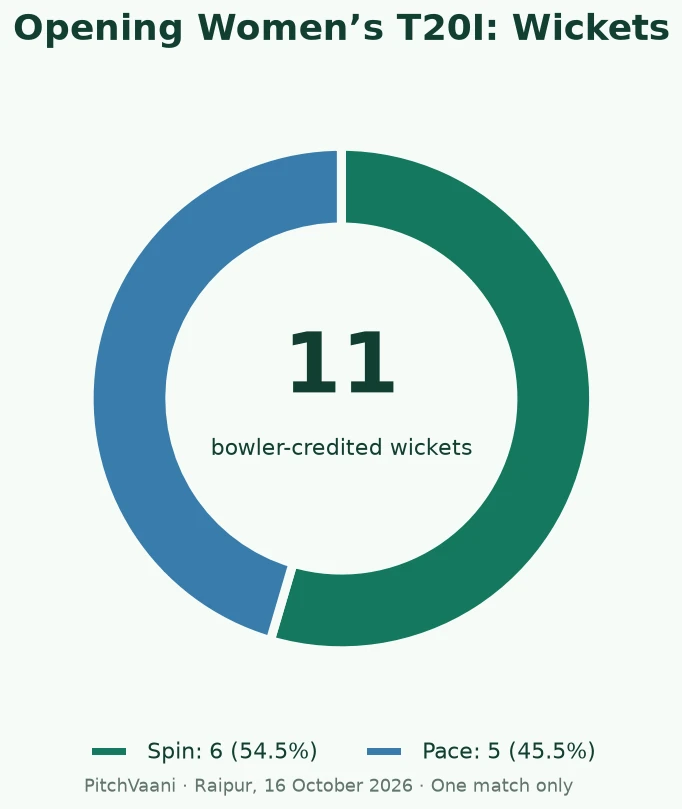
Read the chart values
- Spin: 6 of 11 wickets, 54.5%.
- Pace: 5 of 11 wickets, 45.5%.
Bowling Economy: One-Match Comparison
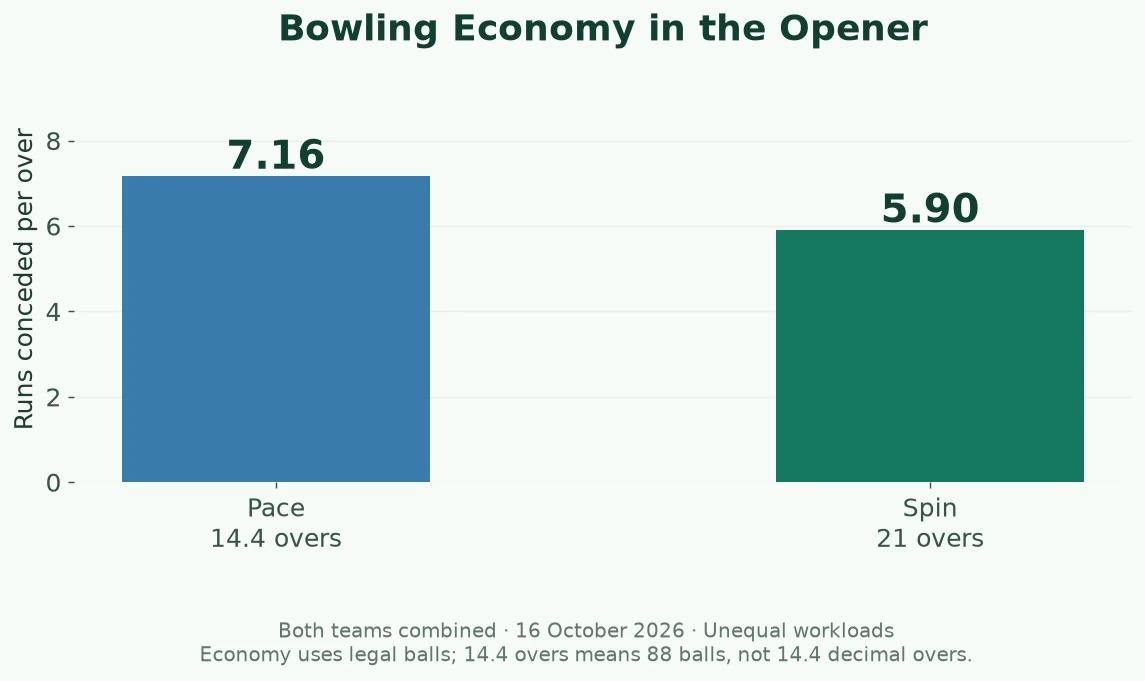
Read the chart values
- Pace: 105 runs from 88 balls, economy 7.16.
- Spin: 124 runs from 126 balls, economy 5.90.
What this does not establish: It does not prove that spin always has the advantage, that the pitch turned consistently, or that a second-match bowler will repeat these figures. Read the women’s match stats alongside the selected XI and observed conditions.
Shaheed Veer Narayan Singh International Stadium Pitch Conditions
The most specific surface evidence is a player’s account of the first match. It should be attributed and dated, not turned into a fixed description of every Raipur pitch.
Surface behaviour in the opener
- Niki Prasad said the pitch “started slowing down a bit and keeping slightly low.”
Can spinners make an impact?
- Nyasha Gwanzura: 3/18 in three overs.
- Sree Charani: 1/14 in four overs.
What to watch on 18 October
- Confirm the selected strip, visible moisture, bounce and how consistently the ball comes onto the bat.
Surface observations are from the first-T20I commentary and post-match interviews. Individual commentary notes also describe deliveries with extra bounce, so “always low” would be too strong.
Batting vs Bowling: Who Has the Advantage?
The opener showed that a batter’s approach and a bowler’s execution could matter as much as the ground’s reputation. For the second T20I, judge whether the selected surface rewards clean timing or makes rebuilding more important.
1. Batters who can attack
- Smriti Mandhana and Shafali Verma are attacking options in India’s announced squad.
- They made nine and four respectively in the opener, so intent alone did not secure a strong start.
2. Batters who can build an innings
- Deepti Sharma and Niki Prasad rebuilt India’s chase.
- Sharne Mayers finished 43 not out, while Kelis Ndhlovu made 42 for Zimbabwe.
3. Bowlers who can change the game
- Nandni Sharma’s four-over spell cost 11 runs and brought two wickets.
- Gwanzura’s three wickets disrupted India’s top order.
Overall assessment: The first match supports a balanced view: bowlers could create pressure, and set batters could recover. Neither observation confirms a high-scoring second game or a repeat collapse.
Player references use the announced squads, not a confirmed second-match playing XI.
Dew Factor at Raipur Stadium
Niki Prasad reported substantial dew in the opener and said it made the ball travel faster off the bat. That is useful first-match testimony; it does not establish whether moisture will form at the same time on 18 October.
How can dew affect the match?
- If dew develops, a wet ball may make grip and control harder.
What does Raipur’s chasing result show?
What should fans check?
- The latest pitch inspection and outfield observations.
- Whether the ball and surface are actually becoming wet.
- Updated Raipur weather and the toss discussion.
What Does This Mean for the Toss: Women’s Second T20I?
If dew develops and the strip remains good for batting, chasing may appeal. If moisture is limited, the surface, team balance and bowling plans should carry more weight. The opener’s result is not an automatic instruction to bowl first.
Raipur Stadium T20I First-Innings Score and Competitive Total
Zimbabwe Women’s completed 20-over innings on 16 October.
Before the second T20I, this series offers one scoring observation.
India won by four wickets with 26 balls remaining.
Both equal the only recorded first-innings score. They are not reliable par-score estimates.
With only one completed first innings in this series, the mean and median are necessarily the same: 114. Calculating them adds no evidence of a “typical” Raipur total. The chase score of 116 is not added as another first-innings observation, and men’s T20I, ODI and IPL figures are not used as women’s averages.
What is competitive? There is no supported fixed par score for the second T20I here. A target of 115 tested India early despite being reached with 26 balls left. Use wickets in hand, batting depth, the selected pitch and actual conditions rather than treating 114 as a benchmark.
Completed Opener: First Innings and Chase
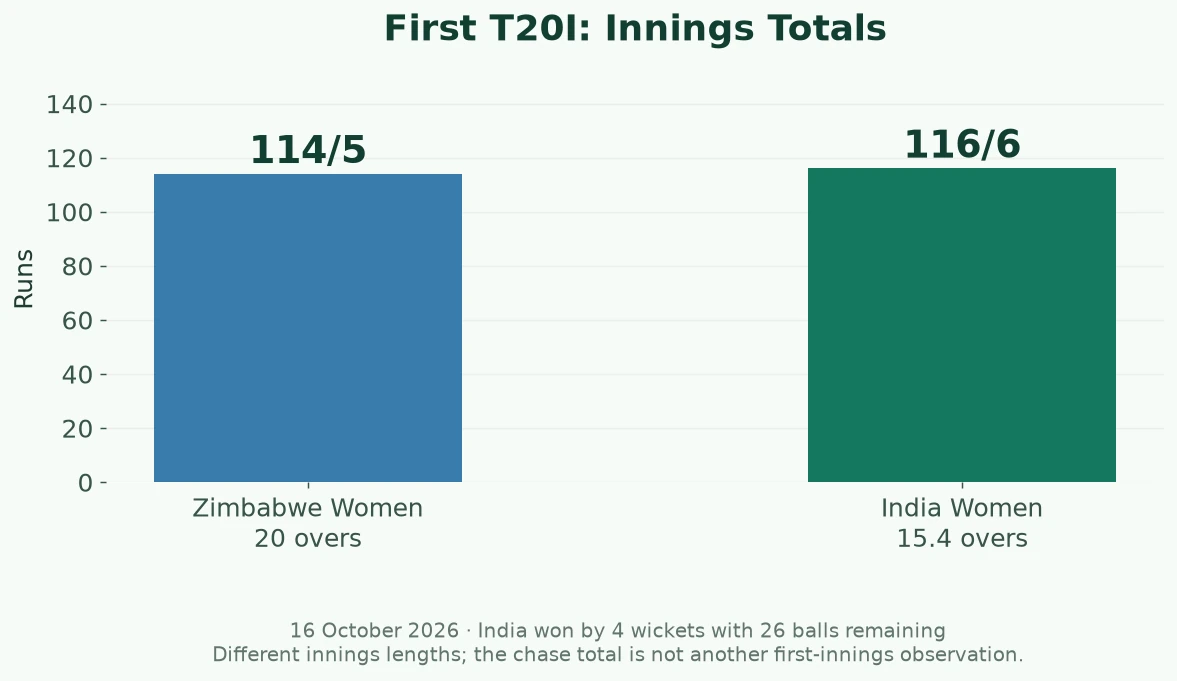
Read the chart values
- Zimbabwe Women: 114/5 in 20 overs.
- India Women: 116/6 in 15.4 overs.
- Result: India won by four wickets, 26 balls remaining.
India Women vs Zimbabwe Women 2nd T20I: What to Expect from the Pitch
The Raipur pitch report for women’s cricket should remain conditional. The opener supplies useful clues, but the selected strip, final XIs and ground conditions need to be checked again for 18 October.
1. Powerplay: Can the top order keep wickets intact?
India’s 19/4 start is a warning against treating a low target as an easy chase. Watch whether batters judge the bounce and length well before increasing their scoring rate.
What to watch: Shot control and early wickets. The opener’s collapse does not by itself prove a moving new ball.
2. Middle overs: Can bowlers sustain pressure?
Spin’s 5.90 economy in the opener provides context, while Nandni’s pace spell also showed control. If the new strip offers grip or uneven timing, accurate bowling could make acceleration harder.
What to watch: Actual turn, changes of pace and strike rotation, rather than assumed spin assistance.
3. Death overs: Can set batters finish strongly?
A settled batter may find boundaries, but a slower or lower surface can change the value of different shots. The opening match contained 31 fours and three sixes across both innings; those are past scoring events, not a forecast.
What to watch: Clean contact, boundary placement and the bowlers’ execution.
4. Toss: Assess the new surface, not just the last result
Confirm whether the captain sees moisture or a change in the strip. One successful chase and a report of first-match dew should inform the discussion without deciding it automatically.
For a separate conditional match assessment, read the second-T20I prediction. No individual score, wicket tally or match result is guaranteed.
Raipur Weather for India Women vs Zimbabwe Women
Forecast checked: 17 October 2026. IMD’s date-labelled Raipur city forecast for 18 October describes mainly clear skies becoming partly cloudy towards afternoon or evening. It lists a daily maximum of 33°C and minimum of 24°C, with no city warning at the time checked.
| Forecast element | Verified context |
|---|---|
| Raipur city sky | Mainly clear, becoming partly cloudy towards afternoon or evening. |
| Daily temperature forecast | Maximum 33°C; minimum 24°C. These are not 7 PM stadium temperatures. |
| City warning | No warning in the dated Raipur city row at the 17 October check. |
| Regional bulletin | Isolated very light to light rain and thunderstorms are forecast regionally, with South Chhattisgarh highlighted. |
| Dew or wet outfield | No confirmed second-match ground observation is provided here. |
The regional IMD bulletin issued 17 October at 12:20 PM IST includes isolated rain and thunderstorm risk, particularly over South Chhattisgarh. A regional warning does not establish that rain will reach the Raipur stadium during the 7 PM match. Weather can change, so check later official updates; neither a delayed toss nor a washout is confirmed here.
Daily temperature forecasts are not hourly match-window observations, and humidity alone cannot confirm dew. For travel and event checks, see the Raipur women’s match-day guide.
Recent Women’s Match at Raipur: Completed and Scheduled
| Date | Fixture | First innings | Second innings | Status |
|---|---|---|---|---|
| 16 Oct 2026 | India Women vs Zimbabwe Women · 1st T20I | Zimbabwe 114/5 (20) | India 116/6 (15.4) | India won by four wickets; 26 balls remaining. |
| 18 Oct 2026 | India Women vs Zimbabwe Women · 2nd T20I | Not played at this check | Not played at this check | Scheduled for 7 PM IST; no confirmed toss, XI or result here. |
The women’s T20I ground ledger lists one completed match at this check: the 16 October opener. The second fixture will therefore be the venue’s second women’s T20I. A one-match venue sample remains too small to establish a stable average or chasing trend. Follow the women’s fixtures and results for match status, and use the stadium matches page for broader venue context.
Raipur Stadium Boundary Length: What Can Be Confirmed?
A match-specific straight and square boundary graphic for the women’s second T20I has not been verified here. Do not treat an older generic stadium estimate as the current rope distance. The playing strip, direction of the shot and boundary position all affect the distance a batter must clear.
Check the current broadcast graphic before analysing six-hitting. No fixed shortest direction, surveyed playing area or exact 18 October boundary plan is claimed in this Raipur pitch report.
First-Match Highlights and Best Performers
These are highlights from the women’s series opener, not all-time ground records. The Raipur stadium records page covers broader formats separately.
49 off 37 balls in India’s chase.
Three wickets in three overs for Zimbabwe.
Eleven runs from four overs: economy 2.75.
Four Leading Scores in the Opener
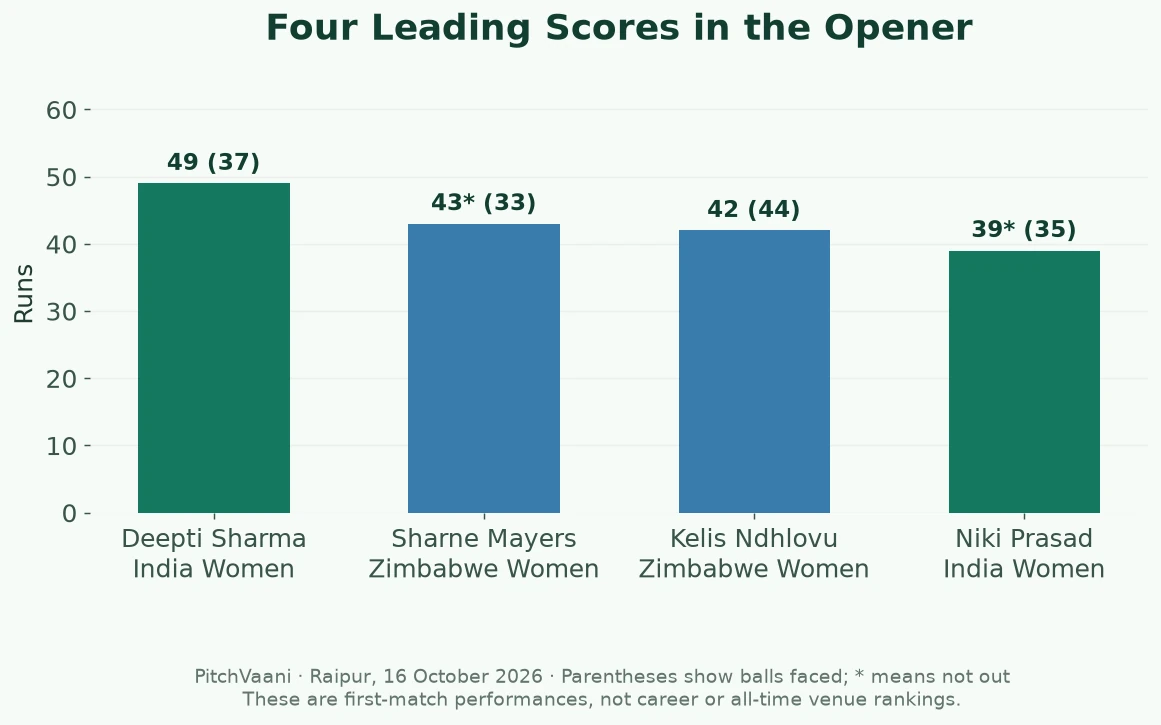
Read the chart values
- Deepti Sharma: 49 off 37 balls.
- Sharne Mayers: 43 not out off 33 balls.
- Kelis Ndhlovu: 42 off 44 balls.
- Niki Prasad: 39 not out off 35 balls.
Leading Run-Scorers and Wicket-Takers in the Opener
The following rankings cover one completed match on 16 October 2026. They are not cumulative career or venue records.
Leading Run-Scorers: First T20I Only
| Player | Team | Runs | Balls | Fours / sixes |
|---|---|---|---|---|
| Deepti Sharma | India Women | 49 | 37 | 8 / 0 |
| Sharne Mayers | Zimbabwe Women | 43* | 33 | 4 / 2 |
| Kelis Ndhlovu | Zimbabwe Women | 42 | 44 | 7 / 0 |
| Niki Prasad | India Women | 39* | 35 | 6 / 0 |
| Modester Mupachikwa | Zimbabwe Women | 16 | 26 | 1 / 0 |
Leading Wicket-Takers: First T20I Only
| Bowler | Team | Type | Overs | Figures / economy |
|---|---|---|---|---|
| Nyasha Gwanzura | Zimbabwe Women | Spin | 3 | 3/18 · 6.00 |
| Nandni Sharma | India Women | Pace | 4 | 2/11 · 2.75 |
| Sree Charani | India Women | Spin | 4 | 1/14 · 3.50 |
| Kranti Gaud | India Women | Pace | 2 | 1/16 · 8.00 |
| Michelle Mavunga | Zimbabwe Women | Pace | 3 | 1/19 · 6.33 |
Frequently Asked Questions
Is Raipur pitch batting or bowling for the women’s second T20I?
The opener offered opportunities to both. Zimbabwe made 114/5 and India recovered from 19/4 to reach 116/6. Niki Prasad reported dew and a surface that slowed and kept slightly low later. These are 16 October observations, not confirmation of the 18 October strip.
What is the Raipur stadium T20I first-innings score in this women’s series?
Zimbabwe Women scored 114/5 in 20 overs in the 16 October 2026 opener. It is the only completed women’s T20I at the venue in the ledger checked before the second match. Its mean and median are both 114 because the sample contains one innings; neither is a reliable par score.
What does the Raipur stadium chasing record tell us?
India won the completed women’s opener by four wickets with 26 balls remaining. One successful chase is a match result, not evidence of a dependable venue-wide chasing advantage or an automatic bowl-first decision.
Will dew affect India Women vs Zimbabwe Women in Raipur?
Niki Prasad reported substantial dew in the first T20I. Dew for the 18 October second match is not confirmed. Check actual ground moisture and toss-time observations rather than assuming that the first match will repeat.
What is the Raipur stadium boundary length for this match?
No verified 18 October 2026 match-specific straight and square boundary graphic is included here. Distances can vary by direction, pitch position and rope placement. Use the current broadcast graphic rather than an older generic stadium estimate.
Do the bowling figures prove that Raipur favours spin?
No. In the opener, spin took six wickets at 5.90 runs per over across 21 overs, while pace took five at 7.16 across 14.4 overs. Different workloads, phases and opponents make this a one-match comparison, not proof of permanent spin assistance.
What is the weather forecast for the 18 October second T20I?
At the 17 October check, IMD’s Raipur city forecast for 18 October described mainly clear skies becoming partly cloudy later, daily maximum 33°C and minimum 24°C, with no city warning. Regional isolated rain warnings do not confirm rain at the stadium. Neither daily temperatures nor humidity confirm dew.
Sources and calculation scope
Scoring and bowling calculations use the completed first-T20I scorecard. Bowling types use the published India and Zimbabwe series squads. Figures include both normal innings of this one match; no men’s, IPL, ODI or domestic data are included.
Surface and dew comments are attributed to the first-match commentary and interviews, alongside the Cricbuzz match report. Weather uses the dated official Raipur city forecast and regional bulletin. No second-match strip, playing XI, dew observation or result is invented.