On the outskirts of Varanasi, a new cricket venue is taking shape at Ganjari in Rajatalab. Known as the Varanasi Cricket Stadium, the upcoming ground combines modern cricket infrastructure with the cultural identity of Kashi.
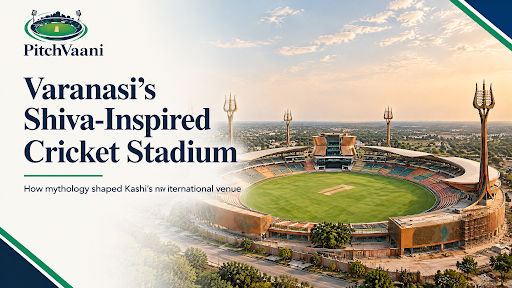
The stadium's design draws inspiration from Lord Shiva, the Ganga River and Varanasi's famous ghats. Crescent-shaped roof covers, trident-inspired floodlights, ghat-style seating and bilva-leaf elements are incorporated into the architectural design.
Prime Minister Narendra Modi laid the foundation stone for the Varanasi Cricket Stadium on 23 September 2023. The project was announced as a stadium spread across more than 30 acres, with a planned capacity of around 30,000 spectators and an overall project cost of approximately ₹450 crore.
Why Lord Shiva Is Central to the Varanasi Cricket Stadium's Design
Varanasi, also known as Kashi, has a deep cultural and spiritual connection with Lord Shiva. The city's identity is closely associated with the Kashi Vishwanath Temple and the traditions of the Ganga.
The design of the Varanasi Cricket Stadium reflects this connection rather than simply adding religious symbols to a conventional sports venue.
According to the architectural concept, forms associated with Lord Shiva—including the trishul, crescent moon and damru—are incorporated into different parts of the stadium. The design also draws from the stepped ghats along the Ganga.
This gives the upcoming cricket ground a distinctly Varanasi-inspired architectural identity.
Five Design Elements That Connect Varanasi Cricket Stadium With Kashi
| Architectural Feature | Cultural Inspiration | How It Appears in the Stadium |
|---|---|---|
| Crescent-shaped roof covers | Crescent moon associated with Lord Shiva | Curved roof and spectator canopy forms |
| Trishul-shaped floodlights | Lord Shiva's trishul | Three-pronged visual design of the lighting structures |
| Damru-inspired pavilion and media centre | Shiva's damru | Architectural form used for the pavilion and media facilities |
| Bilva-leaf facade | Bilva or bel leaves associated with Shiva worship | Bilvipatra-inspired metallic elements on the facade |
| Ghat-inspired seating | Varanasi's riverfront ghats | Stepped spectator seating inspired by the city's famous ghats |
The first four elements are directly connected with the stadium's Shiva-inspired design concept. The ghat-style seating draws from the physical and cultural landscape of Varanasi.
Together, these features make the Varanasi Cricket Stadium more than a standard cricket venue. Its architecture is designed to reflect the city in which it stands.
From Cultural Design to Varanasi Cricket Stadium Engineering
While the cultural design is one of the most discussed aspects of the project, the Varanasi Cricket Stadium is also planned as a modern cricket facility.
The architect's project specification lists nine pitches for the main ground and five pitches on the practice ground. The planned facilities include player changing and recovery areas, medical and physiotherapy facilities, spaces for umpires and coaches, media and press-conference facilities, corporate areas and accessible spectator seating.
The project also includes parking and landscape development around the stadium. Rainwater harvesting, water-storage systems, tree buffers and planted peripheral areas form part of the published design.
One particularly interesting project claim concerns the playing surface. A June 2026 local report quoted project director Saroj Shukla as saying that the drainage system was designed to make the field playable around 30 minutes after prolonged rain stopped.
This remains a project claim rather than a tested match-day result. Its actual performance can only be assessed once the stadium becomes operational.
A Note on the Number of Varanasi Cricket stadium Pitches
Different reports have mentioned different numbers of pitches during the project's development.
A September 2023 report referred to seven pitches, while the architect's later project specification lists nine pitches on the main ground and five on the practice ground.
For the current project description, the architect's later specification is the more relevant reference. However, the final facility count should be verified after construction and handover.
Who Is Building the Varanasi Cricket Stadium?
The Varanasi Cricket Stadium project is associated with the Uttar Pradesh Cricket Association (UPCA).
Larsen & Toubro (L&T) is involved as the engineering, procurement and construction contractor, while Collage Design is associated with the project's master planning, architecture, landscape, interiors, signage and sports-design consultancy.
The project is significant for Uttar Pradesh cricket because it is intended to provide a major cricket venue in Varanasi alongside the state's existing venues in cities such as Kanpur and Lucknow.
Varanasi Cricket Stadium Cost, Capacity and Size
The original project announcement gave the following broad details:
- Location:Ganjari, Rajatalab, Varanasi, Uttar Pradesh
- Land area:More than 30 acres
- Planned capacity:Around 30,000 spectators
- Foundation stone:23 September 2023
- Announced overall project cost:Approximately ₹450 crore
- Theme:Varanasi and Lord Shiva-inspired architecture
The ₹450 crore figure should be understood as the overall project figure announced at the foundation-stone stage. Later reports have quoted different construction-only estimates, which may reflect differences in project scope or whether land costs are included.
For this reason, describing the stadium as an approximately ₹450 crore overall project is more appropriate than presenting later construction estimates as directly comparable figures.
Is the Varanasi Cricket Stadium Complete?
As of 17 September 2026, the Varanasi Cricket Stadium should still be described as under construction rather than operational.
Public reports during June, July and August 2026 gave different progress percentages. Some reports citing project officials placed overall completion at around 92%, while another August report described more than 80% of external development as complete.
The reported status indicates that major parts of the stadium—including pavilions, the media centre, internal works and outfield development—were substantially advanced.
An August 2026 report also quoted the project team as targeting 15 October 2026 for completion of the remaining Damru-related work.
Because the publicly reported completion percentages differ, they should not be treated as directly comparable measurements. The safest description is that the Varanasi Cricket Stadium was in its final construction phase as of September 2026, with October 2026 reported as a specific completion target.
Its final operational status, handover and opening should be confirmed through an official announcement.
What Makes Varanasi Cricket Stadium Different?
The most distinctive feature of the Varanasi Cricket Stadium is the way its architecture connects cricket with the identity of Kashi.
Instead of relying only on conventional stadium architecture, the project incorporates elements associated with Lord Shiva, the Ganga and Varanasi's ghats into functional parts of the venue.
The crescent-shaped roof, trishul-inspired lighting, bilva-leaf facade and ghat-style seating give the stadium a recognizable visual identity. At the same time, its planned cricket infrastructure is designed to meet the requirements of a modern professional venue.
Once completed and operational, the stadium is expected to add a major cricket venue to Varanasi and create a sporting landmark that reflects the cultural character of the city.