Quick Facts
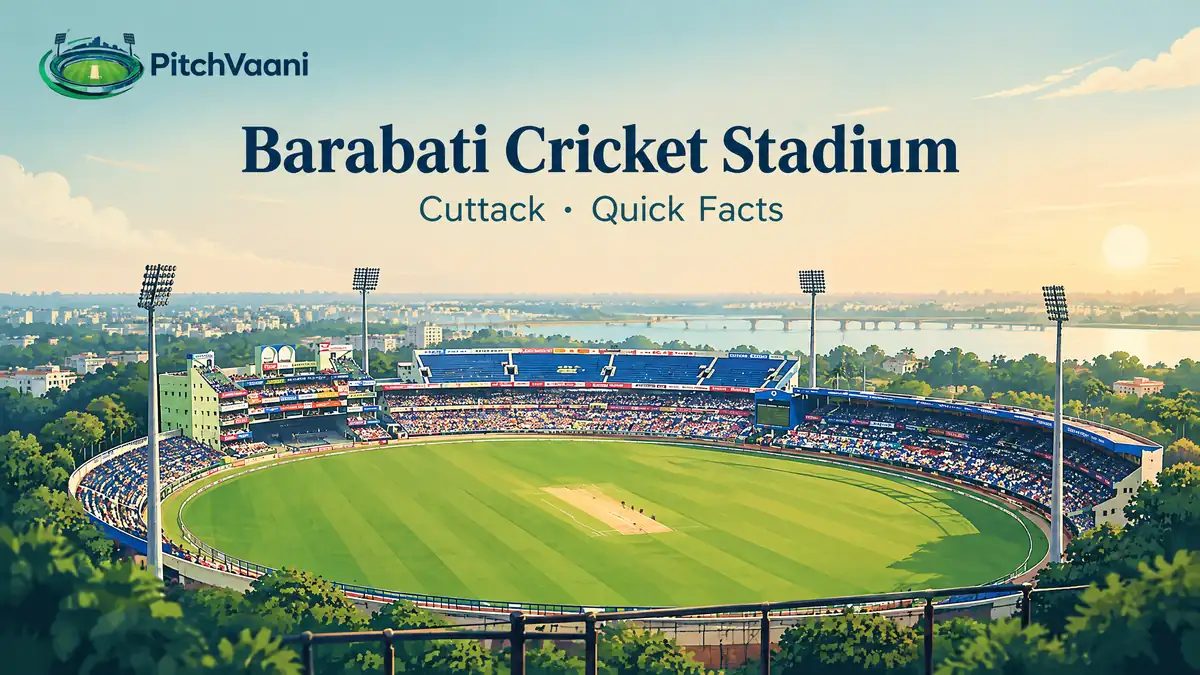
Barabati Cricket Stadium, Cuttack Quick Facts
Barabati Cricket Stadium, Cuttack Quick Facts brings together its 45,000-seat BCCI capacity listing, opening-year references, first international matches, ground dimensions and visitor essentials. Use this table for venue context, then check the organiser’s instructions for your event.
Barabati Cricket Stadium, Cuttack Quick Facts
Source-supported capacity, identity, dimensions, landmark matches and visitor context in one clear table. Source review: 13 October 2026.
| Quick fact | Verified detail |
|---|---|
| Current capacity | 45,000BCCI venue profile. Available seats and ticket inventory depend on the event configuration. |
| Location | Stadium Road, CuttackOdisha, India, near Barabati Fort. Explore the Odisha cricket-ground directory. |
| Commonly listed opening year | 1958National tourism and venue references list 1958. Reporting also dates early construction to 1952; these should not be treated as the same milestone. |
| Home team and cricket operator | Odisha · OCAOdisha is the domestic home team. The Odisha Cricket Association organises cricket at Barabati. |
| About Barabati Stadium | A historic Cuttack cricket venue with international Tests, men’s ODIs, T20Is, domestic cricket and historical IPL use. Read the Barabati Stadium overview. |
| Who drove the stadium initiative? | Bhairab Chandra Mohanty is credited with the initiative and Barabati Raffle fundraising through the Odisha Olympic Association. This is not an assertion that he was the technical construction contractor. See the history of Barabati Cricket Stadium. |
| Playing surface and floodlights | Grass · FloodlitVenue profiles describe a grass surface and floodlights for day-night cricket. |
| Ends | Mahanadi River End · Pavilion EndNames used by the BCCI and ESPNcricinfo venue profiles. |
| Barabati Stadium dimensions | Published estimates: about 65 m square and 70 m straight. These are non-official estimates without a dated measurement method. The selected strip and boundary rope change match-day distances. |
| First men’s ODI | 27 January 1982India vs England. India won by five wickets, according to the venue history. |
| First Test match | 4–7 January 1987India vs Sri Lanka. India won by an innings and 67 runs; Dilip Vengsarkar scored 166. |
| First men’s T20I | 5 October 2015India vs South Africa, as listed in the OCA’s international hosting history. |
| Historic men’s World Cup use | 1987 · 1996Barabati hosted matches at both men’s Cricket World Cups. |
| Women’s international cricket | 2013 Women’s World CupThe ground was among the venues used during the tournament. Women’s and men’s records should be kept separate. |
| Documented bowling milestone | Narendra Hirwani — 6/59Against New Zealand in the rain-affected 1995 Test. A historical performance, not a claim of an all-format venue record. |
| Seating and admission | Use your current event ticket for the stand, block, row, seat and entry gate. No fixed ticket price or unrestricted daily public-entry schedule is assumed. |
| Railway arrival point | Cuttack Railway StationContinue by taxi or auto to the gate designated for your event. Allow for match-day traffic. |
| Airport arrival point | Biju Patnaik International AirportThe airport is in Bhubaneswar. Continue by road to Cuttack; travel time depends on traffic. |
| Pitch and match-day reading | Check the selected strip, recent use, grass cover, moisture, weather and boundary rope. Venue history alone cannot guarantee a batting-friendly or bowling-friendly surface for the next match. |
| Redevelopment context | A reported 60,000-seat redevelopment proposal is not the current capacity. A proposal does not establish completion; the BCCI’s published 45,000-seat venue figure is used above. |