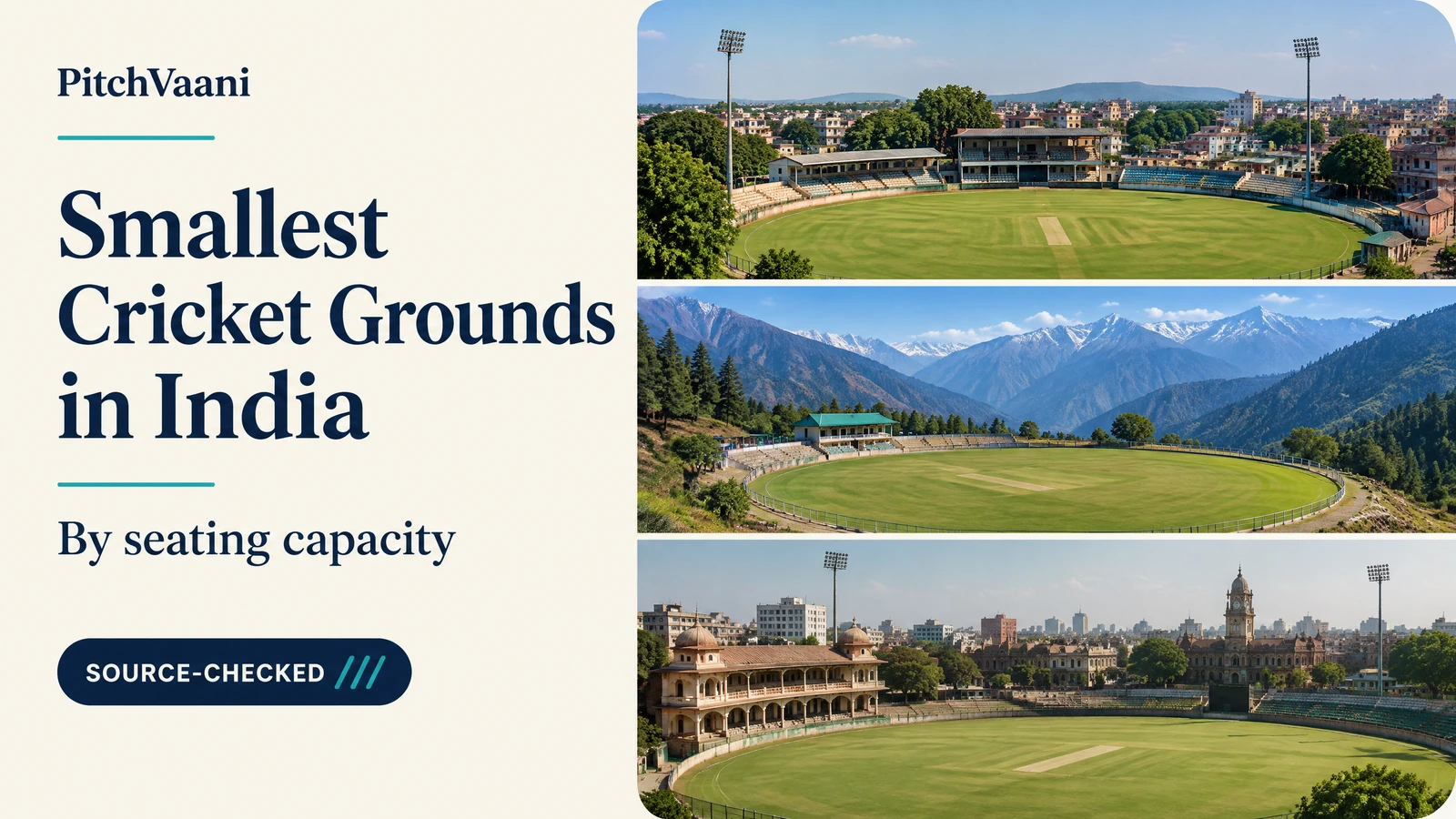
Searching for the smallest cricket grounds in India sounds simple, but the underlying data is not. Published capacities may refer to permanent seats, nominal attendance, temporary stands or historical layouts. Instead of presenting an invented nationwide ranking, this guide compares 10 notable venues that appear in smaller-capacity records and explains the quality of each figure.
The list is ordered broadly by reported capacity, not certified rank. Asterisks mark figures that are disputed, database-listed without a current seating audit, or not confirmed by the venue authority. Capacity and access should be rechecked before an event.
Small-capacity cricket grounds in India at a glance
| Venue | Reported capacity | City | Evidence note |
|---|---|---|---|
| Sher-i-Kashmir Stadium | Approx. 5,000* | Sonwar, Srinagar | Recent reported estimate; official current capacity unavailable |
| Lalbhai Contractor Stadium | Approx. 6,000–7,000 | Vesu, Surat | Association and database figures differ |
| Tau Devi Lal Cricket Stadium | About 7,000 | Sector 3, Panchkula | Approximate ESPNcricinfo capacity |
| Bhausaheb Bandodkar Ground | About 10,000* | Campal, Panaji | Database-listed capacity; current audit not found |
| Fort Maidan | About 10,000* | Palakkad | ESPNcricinfo-listed capacity |
| Nagaland Cricket Stadium | Approx. 10,000–12,000* | Sovima, Chümoukedima | Published estimates vary; current official figure unavailable |
| Dhruve Pandove Stadium | Reported 10,000–22,000* | Baradari, Patiala | Materially disputed capacity estimates |
| Moti Bagh Stadium | Commonly listed near 18,000* | Vadodara | Commonly listed estimate; primary capacity source not found |
| Brabourne Stadium | About 20,000 | Churchgate, Mumbai | ESPNcricinfo-listed capacity |
| HPCA Stadium | Approx. 21,200–23,000 | Dharamshala | Current sources vary between 21,200 and 23,000 |
10 compact cricket venues and key facts
Sher-i-Kashmir Stadium
Sonwar, Srinagar · Jammu & KashmirRecent reports commonly place this historic ODI and domestic venue near 5,000 seats, but the current official seating figure was not located. The ground staged India–West Indies in 1983 and India–Australia in 1986.
- Timeline
- Established / first recorded in 1983
- Venue authority
- Jammu and Kashmir Cricket Association
- Capacity note
- Recent reported estimate; official current capacity unavailable
Lalbhai Contractor Stadium
Vesu, Surat · GujaratThis Surat District Cricket Association venue entered major recorded cricket in 1993. SDCA describes a pavilion for about 7,000 spectators, while ESPNcricinfo lists 6,000, so a range is more honest than one exact number.
- Timeline
- ESPNcricinfo lists 1993
- Venue authority
- Surat District Cricket Association
- Capacity note
- Association and database figures differ
Tau Devi Lal Cricket Stadium
Sector 3, Panchkula · HaryanaBuilt in 2005 within the Haryana-government sports complex, this compact venue became widely known through the Indian Cricket League’s inaugural 2007–08 tournament matches.
- Timeline
- Built in 2005
- Venue authority
- Haryana-government sports complex
- Capacity note
- Approximate ESPNcricinfo capacity
Bhausaheb Bandodkar Ground
Campal, Panaji · GoaAlso recorded as Campal Grounds and Panjim Gymkhana Grounds, this venue is linked with Panjim Gymkhana and has match records dating from the mid-1960s. Its 10,000 figure is a database listing rather than a current seating audit.
- Timeline
- Venue listings date it to 1963
- Venue authority
- Associated with Panjim Gymkhana
- Capacity note
- Database-listed capacity; current audit not found
Fort Maidan
Palakkad · KeralaFort Maidan, also called Kota Maidanam, sits opposite Palakkad Municipal Office. Its first recorded first-class match was Kerala v Punjab in November 2003; that date should not be presented as the ground’s original opening year.
- Timeline
- First recorded first-class match: November 2003
- Venue authority
- Palakkad District Cricket Association / KCA
- Capacity note
- ESPNcricinfo-listed capacity
Nagaland Cricket Stadium
Sovima, Chümoukedima · NagalandThe state-built stadium was reported ready in 2012. It must not be confused with Sovima Cricket Ground, a separate second NCA venue. Published capacity estimates vary and no authoritative current seating statement was located.
- Timeline
- Built and ready in 2012
- Venue authority
- Nagaland Cricket Association venue
- Capacity note
- Published estimates vary; current official figure unavailable
Dhruve Pandove Stadium
Baradari, Patiala · PunjabCricketArchive records play at the site from 1926/27 and the Dhruve Pandove name from 1992/93. Capacity sources conflict sharply: ESPNcricinfo lists 10,000, while a 2011 report quoted 22,000 seats. A precise rank would therefore be misleading.
- Timeline
- Cricket recorded from 1926/27
- Venue authority
- Patiala / Punjab cricket venue
- Capacity note
- Materially disputed capacity estimates
Moti Bagh Stadium
Vadodara · GujaratLocated within the Laxmi Vilas Palace complex, Moti Bagh has recorded cricket from 1956/57 and hosted India v West Indies in its first ODI in 1983. The commonly repeated 18,000 figure still needs direct BCA confirmation.
- Timeline
- First recorded match: 1956/57
- Venue authority
- Associated with Baroda cricket / BCA
- Capacity note
- Commonly listed estimate; primary capacity source not found
Brabourne Stadium
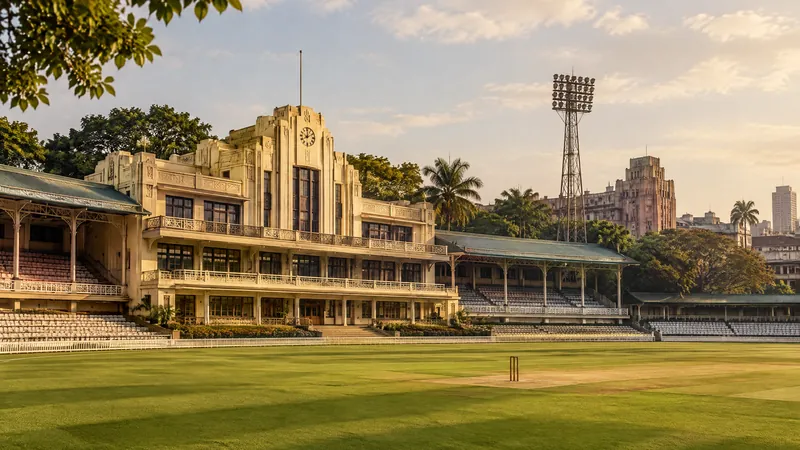
Churchgate, Mumbai · MaharashtraCricket Club of India officially inaugurated Brabourne Stadium on 7 December 1937. ESPNcricinfo lists about 20,000 capacity, making it a relatively compact major international venue rather than proof of an all-India smallest rank.
- Timeline
- Officially inaugurated 7 December 1937
- Venue authority
- Cricket Club of India
- Capacity note
- ESPNcricinfo-listed capacity
HPCA Stadium
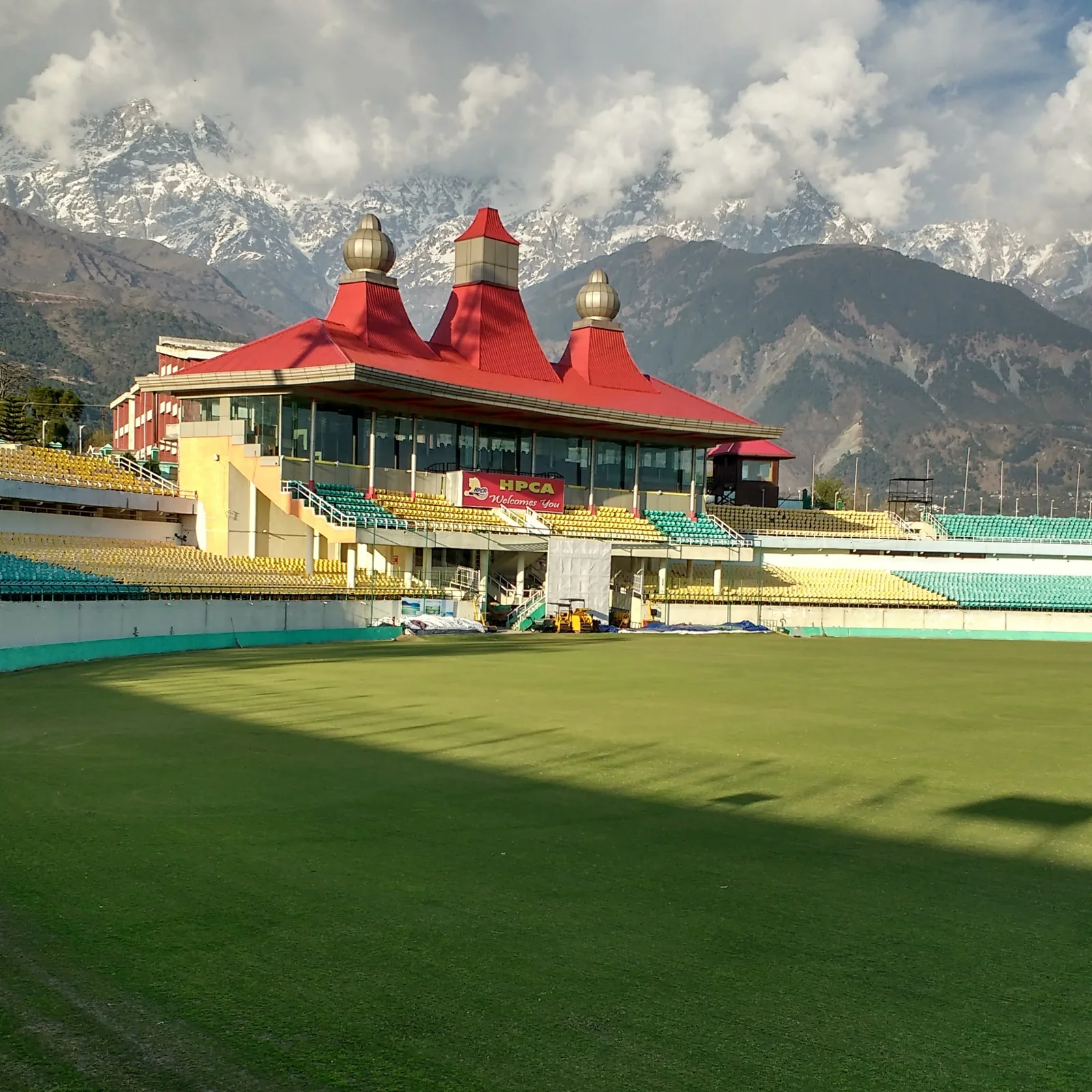
Dharamshala · Himachal PradeshEstablished in 2003 and operated by the Himachal Pradesh Cricket Association, the Dharamshala venue is one of India’s smaller major international grounds. Government and database sources differ, so the published range is retained.
- Timeline
- Established in 2003
- Venue authority
- Himachal Pradesh Cricket Association
- Capacity note
- Current sources vary between 21,200 and 23,000
Why Green Park Stadium is not in this list
The submitted draft gave Green Park two conflicting figures: about 18,000 in the table and about 32,000 in the profile. The current Kanpur district government figure is 32,000, while established cricket records carry higher alternative or historical figures. Green Park is therefore too large for this shortlist and has been removed rather than forced into a misleading ranking.
How to read cricket-ground capacity figures
A stadium’s capacity is not always one permanent number. Renovation work, safety certification, media areas, hospitality blocks and temporary seating can change how many spectators an event can admit. Database figures are useful for comparison, but the venue authority or event organiser remains the best source for current entry arrangements.
Which is the smallest cricket ground in India?
No defensible nationwide answer is available from a complete, standardised public seating dataset. Within this selection, recent reports place Sher-i-Kashmir Stadium near 5,000, but a current official seating statement was not located.
Why do cricket stadium capacity figures vary?
Sources may count fixed seats, standing areas, temporary stands or an older stadium configuration. That is why this article uses ranges and evidence notes instead of false precision.
Which smaller international venues are included?
Brabourne Stadium and HPCA Stadium are established international venues with reported capacities around 20,000 to 23,000. Moti Bagh and Sher-i-Kashmir also have ODI history, although their current capacity evidence is less certain.
The PitchVaani perspective
A smaller reported capacity does not make a cricket ground less significant. Venues such as Brabourne Stadium, HPCA Stadium and Sher-i-Kashmir Stadium show that history, setting, playing conditions and match context can matter more than seat count. For PitchVaani, the useful question is not only which venue is smallest, but how its scale shapes atmosphere, access and cricketing identity.