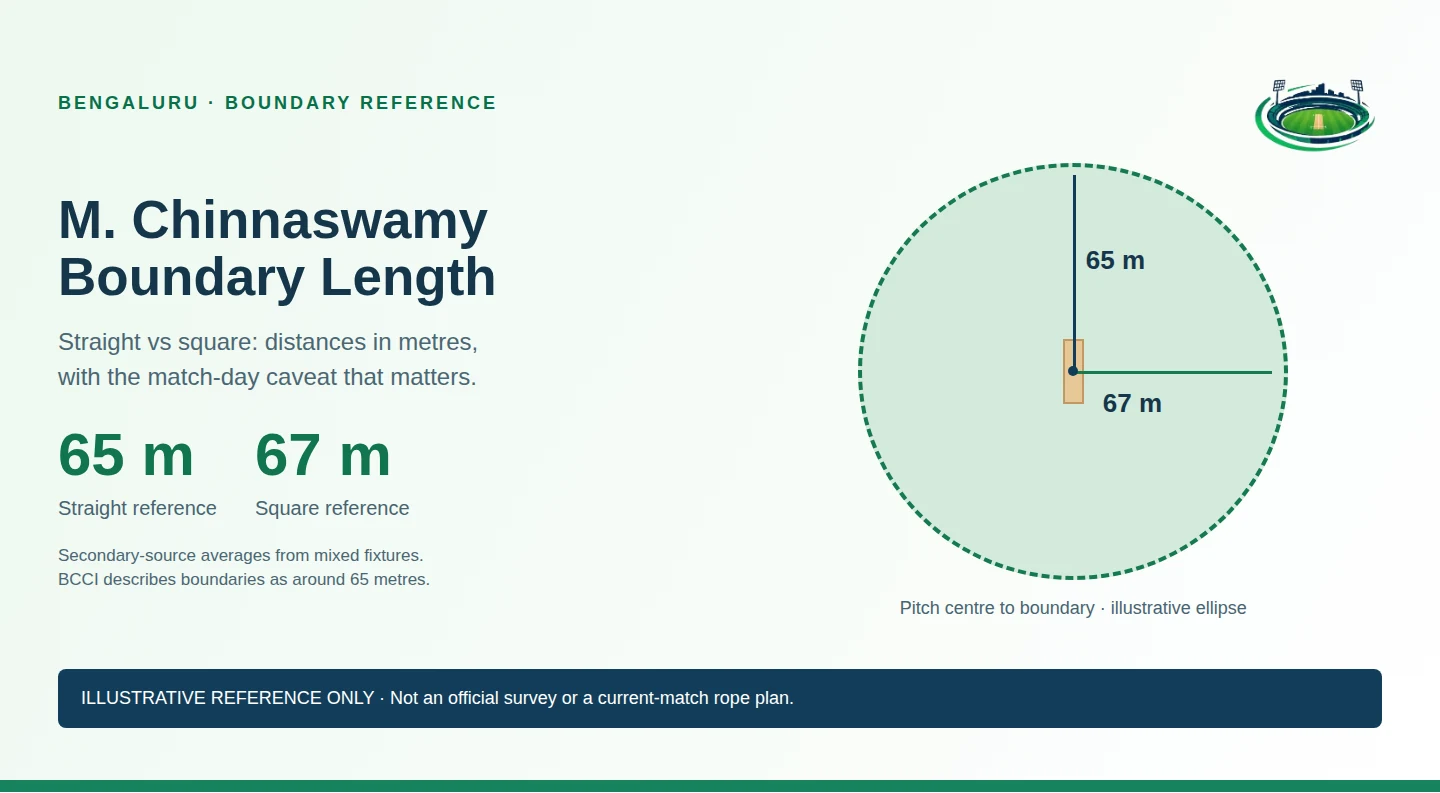
The M. Chinnaswamy Stadium boundary length in Bengaluru is commonly reported to be around 65 metres. A secondary source lists average distances of 65 metres straight and 67 metres square. These figures offer a useful guide to the ground’s relatively short boundaries, but they should not be treated as exact measurements for every direction or match. The actual boundary distance can vary with rope placement.
If you’re checking Chinnaswamy ground size in metres, start with the direction of the shot. A boundary distance runs from the pitch centre towards the rope; it is not the full diameter of the ground. This guide connects the distances with verified six-hitting data and explains why the actual layout still matters. Explore the M. Chinnaswamy Stadium overview for the wider venue guide.
M. Chinnaswamy Stadium Boundary Length: Straight and Square
M. Chinnaswamy Stadium in Bengaluru has commonly reported boundary distances of approximately 65 metres straight and 67 metres square. These figures are secondary-source averages, not verified measurements for every boundary direction.
| Boundary direction | Approximate distance |
|---|---|
| Straight | 65 metres |
| Square | 67 metres |
What do these distances mean for batters?
The straight boundary is reported to be slightly shorter than the square boundary. However, these reference figures alone cannot establish which direction is easiest for six-hitting. The actual distance depends on the direction of the shot, the precise boundary point and the rope position on match day.
Match-day note: Boundary dimensions can vary with rope placement and the playing strip in use. Check the current broadcast boundary graphic before using a specific distance to analyse a six or compare individual shots.
Down the ground
Approximate distance reported by secondary sources.
Understand the direction → Square boundary67 mAcross the pitch
Approximate distance reported by secondary sources.
Compare the direction → Illustrative playing area13,682 m²Ellipse estimate
Model-based estimate, not a measured stadium area.
See how it is calculated → Secondary-source index39/100“Moderate” rating
A source-specific score, not a six-hitting probability.
Read the limitations →What Do These Dimensions Mean for Batters?
65 metres
Hitting straight down the ground
A batter hits the ball straight past the bowler or back over their head. The reported average distance is 65 metres. A well-timed lofted shot may clear the boundary, but it depends on the power and height of the hit.
*Approximate reference from secondary sources.
67 metres
Hitting across the pitch
A batter hits the ball towards the left or right side of the pitch. Pulls and cuts are common examples. The reported average distance is 67 metres—two metres longer than the straight reference. That does not automatically make a six harder; the shot angle and the actual boundary distance also matter.
*Approximate reference from secondary sources.
For bowling and surface context alongside the M Chinnaswamy Stadium boundary length, read PitchVaani’s Chinnaswamy Stadium pitch report. Boundary size alone does not confirm a flat pitch, turn, swing or a par score.
Chinnaswamy Stadium Ground Size: Understanding the Diagram
The diagram above is an illustrative ellipse based on the reported straight and square boundary distances. It is not an official stadium map or a satellite measurement.
The estimated area of 13,682 m² comes from an ellipse calculation using 65 metres and 67 metres as the two semi-axes. This is a mathematical estimate, not the measured area of the actual playing field or the entire stadium.
Looking for stand locations and entry gates? See our Chinnaswamy Stadium seating arrangement guide.
M Chinnaswamy Stadium Boundary Length vs Actual Six-Hitting
Short boundaries can help a clean strike clear the rope, but the more useful question is how teams actually scored. PitchVaani recalculated the following figures from the Cricsheet archives checked on 17 October 2026. The IPL venue sample ends on 24 April 2026; the completed men’s T20I sample ends on 17 January 2024. Neither includes a later match result.
1,592 sixes across 104 match entries
Includes both innings and shortened or no-result entries.
Runs scored through fours and sixes
21,020 of 34,294 recorded runs—not the percentage of balls hit for boundaries.
Median score: 176
Based on 95 eligible innings, excluding shortened innings and no-results.
127 sixes in 9 completed matches
Regulation play through 17 January 2024; Super Overs excluded.
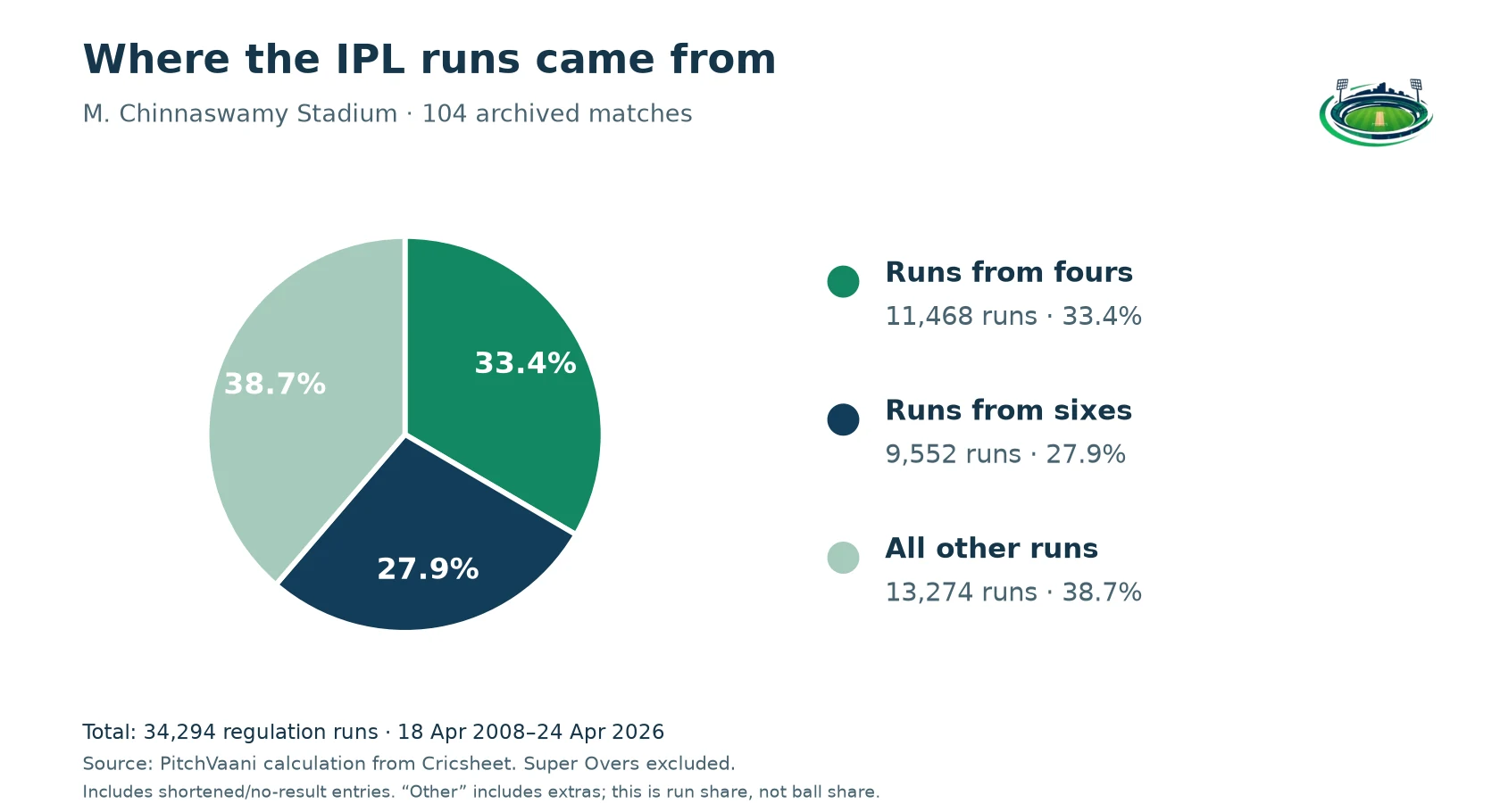
What the pie chart shows: more than three-fifths of recorded IPL runs in this sample came from boundary fours and sixes combined. The remaining 38.7% still matters: batters also scored through running and teams received extras. Compact boundaries do not remove the need to rotate strike.
IPL vs Men’s T20Is: Keep the Samples Separate
| Measure | IPL archive | Completed men’s T20Is |
|---|---|---|
| Sample | 104 match entries, 2008–24 April 2026 | 9 matches, 2012–17 January 2024 |
| Sixes, both innings | 1,592 | 127 |
| Sixes per match | 15.3 | 14.1 |
| Runs from fours and sixes | 61.3% of 34,294 runs | 57.2% of 2,845 runs |
| First-innings average | 178.09 across 95 eligible innings | 161.67 across 9 innings |
| First-innings median | 176 | 156 |
The difference in sixes per match is descriptive. The samples cover different eras and teams, and the IPL archive includes rain-affected entries. It does not prove that an IPL rope was shorter or that international batters find the venue harder.
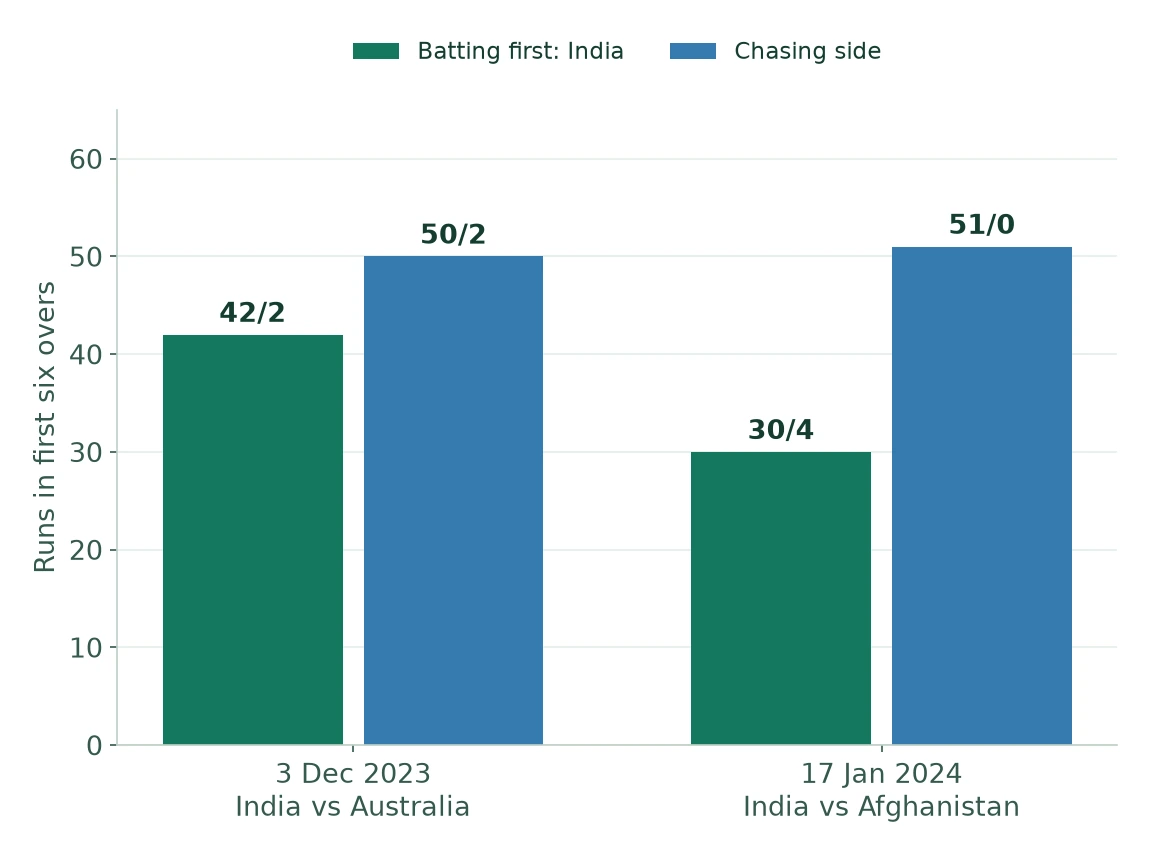
A clear T20I example: India and Afghanistan each scored 212 in regulation on 17 January 2024. India hit 14 sixes and Afghanistan hit 12, for 26 regulation sixes. The match scorecard also shows why this game must be handled carefully: its Super Overs are separate from the two 20-over innings. Explore the highest T20I scores at Chinnaswamy for the team-total context.
Which Boundary Is Shortest at Chinnaswamy?
There is no single permanent shortest direction verified here. A 16 April 2023 report described fine leg for a right-hander at 54 metres during the 10 April RCB–LSG IPL fixture. It placed square regions around 65 metres and straighter or diagonal regions around 70 metres.
That is a dated example of an uneven match layout, not a replacement for the 65/67 reference average. Keep the fixture attached to the 54-metre claim. For the match itself, read the highest successful IPL run chase at Chinnaswamy.
What about the longest six?
A broadcast distance describes a particular shot, not the distance to the rope. This guide does not declare a venue-wide longest-six record without a verified, consistent all-match register. A long six and a short boundary are different measurements.
Chinnaswamy vs Other Indian Cricket Grounds
The table uses one secondary reference provider to avoid blending unsourced numbers. Its measurement provenance still differs between venues: Chinnaswamy mixes broadcast fixtures, Wankhede cites an IPL graphic, Hyderabad is labelled satellite measured, and Eden Gardens uses published figures without a figure-level source. Treat this as an approximate comparison, not a same-method survey.
| Ground | Straight | Square | Reference caveat |
|---|---|---|---|
| M. Chinnaswamy, Bengaluru | 65 m | 67 m | Mixed IPL/2023 World Cup broadcast average |
| Rajiv Gandhi International, Hyderabad | 71 m | 68 m | Source-labelled satellite reference |
| Wankhede, Mumbai | 65 m | 71 m | Published IPL broadcast graphic |
| Eden Gardens, Kolkata | 71 m | 66 m | Published reference; original figure-level evidence not supplied |
In these references, Chinnaswamy shares Wankhede’s straight distance but has a shorter square average. Eden’s square value is slightly shorter than Chinnaswamy’s despite its longer straight figure. A ground cannot be called smaller in every direction from one number alone.
Comparison references: Chinnaswamy, Hyderabad, Wankhede and Eden Gardens.
Does the 39/100 Index Predict a Six?
No. The Cricket Boundary labels its own six-hitting difficulty index 39/100, “moderate”. This is the provider’s illustrative index. PitchVaani has not independently validated it as a player-performance model, and it is not a 39% six probability or a prediction of how many sixes a match will contain.
The verified scoring sample is more useful than treating the index as certainty. A boundary reference does not capture delivery quality, a batter’s contact, wind, field placement or the selected pitch.
The provider lists this score against its catalogue of grounds but does not publish a reproducible score formula on its venue or methodology pages. PitchVaani therefore retains it only as a source-attributed rating, not an independently verified difficulty calculation.
Read the Rope, Not Just the Stadium’s Reputation
The M Chinnaswamy Stadium boundary length offers a useful starting point: around 65 metres officially described, with 65 m straight and 67 m square as qualified reference averages. The recorded six-hitting supports the venue’s compact-boundary reputation, but it does not make every delivery easy to hit.
For a match-day assessment, use the actual boundary graphic, selected pitch and bowling plans together. Do not apply a dated short-side measurement to a new fixture or use an IPL average as a guaranteed international score.
M Chinnaswamy Stadium Boundary Length: FAQs
What is the straight boundary length of M. Chinnaswamy Stadium?
A commonly listed reference estimate is 65 metres straight. BCCI describes the venue’s boundaries generally as around 65 metres. The separate 65-metre value is a secondary-source average, not the exact straight boundary for every fixture.
What is the square boundary length at Chinnaswamy Stadium?
The reference dataset lists an average square boundary of 67 metres. Square means across the pitch, towards the off-side or leg-side square region. The two sides need not be equal, and the actual match rope can differ.
Is M. Chinnaswamy Stadium a small boundary ground?
Its around-65-metre boundary context makes it a compact hitting ground, but not every direction is equally short. This does not establish that it is India’s smallest stadium. Boundary distance, playing area and spectator capacity are different measures.
Why are so many sixes hit at M. Chinnaswamy Stadium?
The archived IPL sample contains 1,592 regulation sixes across 104 match entries, or 15.3 per match. Compact boundaries can be one factor, but batter quality, delivery length, pitch conditions and the chosen rope positions also affect six-hitting.
How does Chinnaswamy’s boundary size compare with Rajiv Gandhi Stadium?
The same secondary dataset lists Chinnaswamy at 65 metres straight and 67 metres square, compared with 71 metres and 68 metres at Rajiv Gandhi International Stadium in Hyderabad. These are approximate source references with different measurement provenance, not a like-for-like survey of current match ropes.
Does boundary distance change between IPL and international matches?
It can. Rope placement and the selected pitch can change by fixture. Do not assume that an IPL broadcast graphic also describes an ODI or T20I layout. Use the boundary graphic or verified venue information for the match being played.
Does Chinnaswamy ground size in metres mean the full diameter?
No. A boundary distance is measured from the centre of the pitch towards a particular part of the rope. The 65-metre and 67-metre reference values are centre-to-boundary distances, not the ground’s full end-to-end width or the area of the stadium complex.
Which boundary is the shortest, and what is the longest six at the venue?
There is no verified permanent shortest direction in this guide. A dated report described a 54-metre fine-leg boundary for the 10 April 2023 RCB–LSG IPL game; that figure must stay tied to that fixture. A venue-wide longest-six record is not listed here because no consistent, verified all-match distance register has been established.
Explore More Chinnaswamy Guides
Chinnaswamy Stadium Pitch Report
Scoring history, bowling data and surface considerations.
Read the pitch report →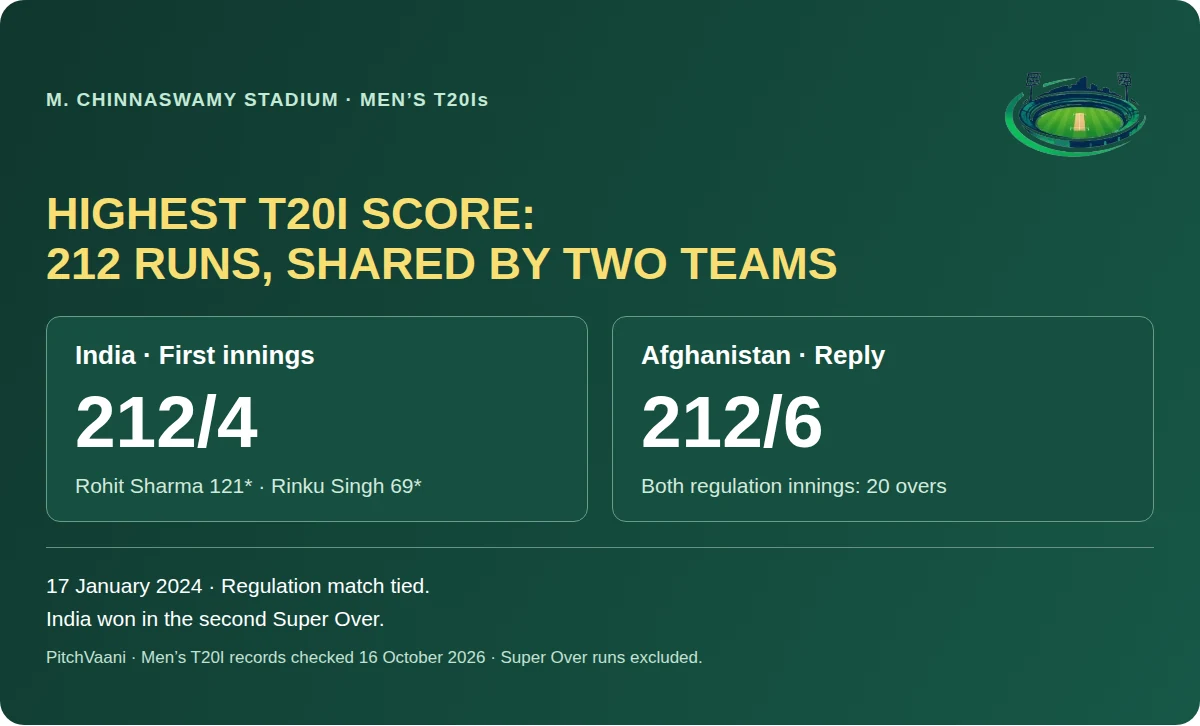
Highest T20I Scores at Chinnaswamy
Compare international team totals without mixing in IPL records.
Explore the T20I records →
Hyderabad Boundary Length Guide
Understand a second venue’s straight and square references.
Compare Hyderabad’s boundaries →Data Notes
IPL: regulation innings in 104 venue match entries, including shortened and no-result entries. Sixes per match is total sixes in both innings divided by 104. The first-innings average uses 95 full-length or all-out innings, excluding no results and shortened first innings.
Men’s T20Is: eight completed matches from Cricsheet supplemented with the 17 January 2024 India–Afghanistan scorecard, making nine. The June 2022 no result and all Super Overs are excluded. Boundary-run share means runs credited to batter boundary fours and sixes divided by total team runs; other runs include extras.
Archive data: IPL JSON archive and men’s T20I JSON archive, with Cricsheet attribution under ODC Attribution 1.0. Measurement definitions: The Cricket Boundary method. Checked 17 October 2026; sample endpoints are stated above rather than implied to be live match coverage.