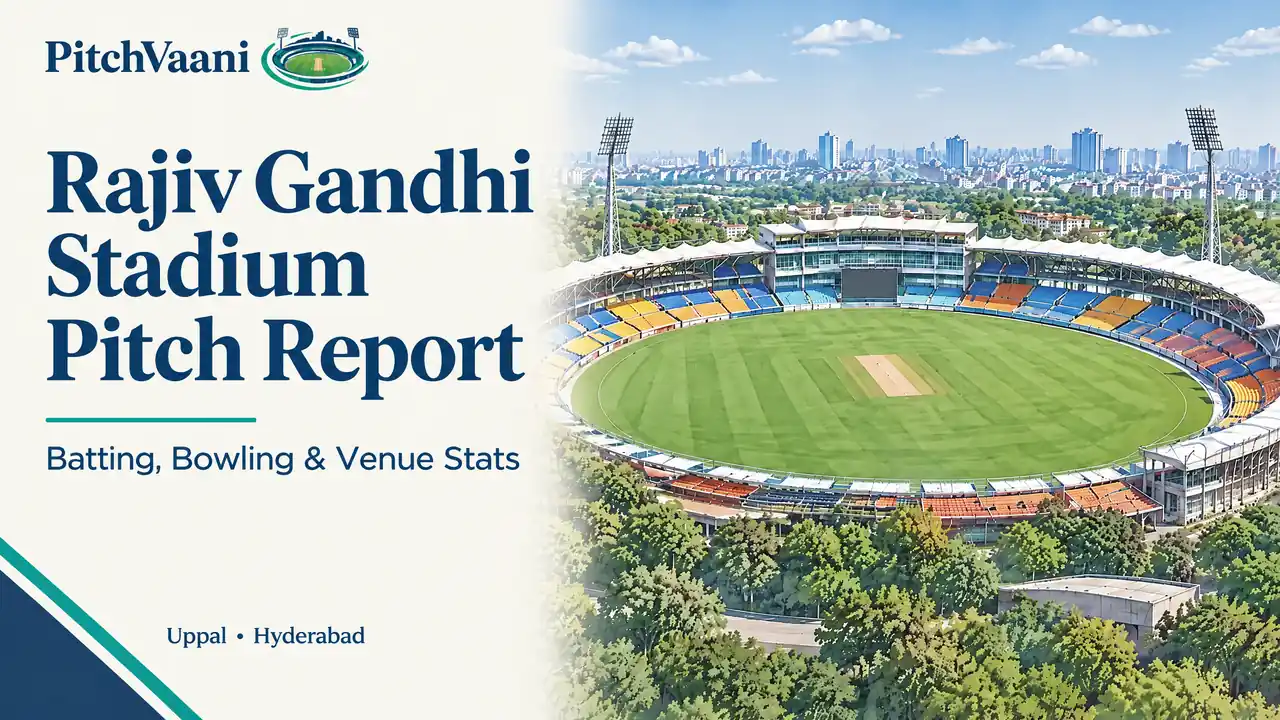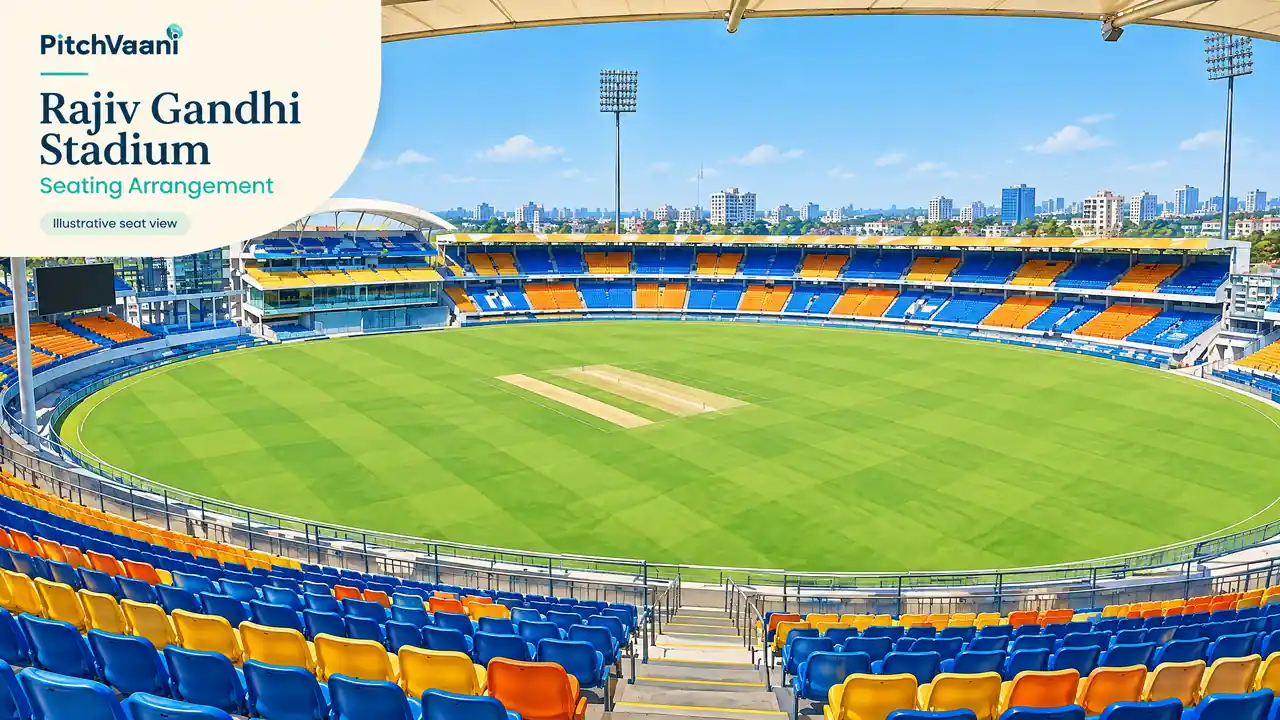
For the India vs West Indies 4th T20I on 14 October 2026, boundary length could influence shot selection, six-hitting opportunities and bowling plans. However, the actual boundary layout for the 14 October international match should be confirmed separately.
Rajiv Gandhi Stadium Boundary Length at a Glance
| Match and date | Reported side or square-side boundaries | Reported straight boundary |
|---|---|---|
| SRH vs Rajasthan Royals — 23 March 2025, IPL | 63 m and 70 m | 76 m |
| SRH vs Mumbai Indians — 23 April 2025, IPL | 63 m and 70 m | 77 m |
| SRH vs Chennai Super Kings — 18 April 2026, IPL | 63 m and 67 m | 77 m |
Sources: Cricbuzz: SRH vs RR, The Indian Express: SRH vs MI, and Cricbuzz: SRH vs CSK.
These are verified, dated IPL pitch-report measurements, not an official surveyed plan of the ground or confirmed rope distances for the 14 October 2026 T20I.
Reading the measurements: The March 2025 source explicitly calls the two side distances square boundaries. The April 2025 report describes left and right distances, while the April 2026 report identifies the bowling end and the batter's handedness. These labels are not interchangeable with permanent East or West boundary measurements.
Rajiv Gandhi Stadium Straight Boundary
The straight boundary is the distance from the pitch towards the rope at either end of a straight hit, such as a lofted drive over the bowler.
The IPL reports listed above give straight-boundary measurements of 76 metres in March 2025 and 77 metres in April 2025 and April 2026.
If this fixture's straight boundary is similar, batters may need clean contact and sufficient elevation to clear the rope consistently. They can also choose to play along the ground rather than attempting a six from every scoring opportunity.
These historical figures do not confirm the straight boundary distance for the 14 October T20I.
For surface conditions and scoring context, read the Rajiv Gandhi Stadium pitch report.
Rajiv Gandhi Stadium Square Boundary
Square boundaries extend across the pitch towards the sides of the ground. The distance to either side can differ, depending on the pitch position and the boundary layout.
The March 2025 IPL report lists square boundaries of 63 metres and 70 metres. The April 2026 report describes side distances of 63 metres and 67 metres.
If the match uses a similar difference, batters may find that shots hit towards the shorter side require less distance to clear the rope. Pull shots, cuts and shots through the leg side or off side could become useful scoring options, depending on the delivery and batter's handedness.
The shorter side should not automatically be labelled east, west, off-side or leg-side without confirming the match orientation.
Uppal Stadium Boundary Length in Meters: Small or Big?
The checked Uppal Stadium boundary length in meters examples combine a shorter side of 63 metres with a longer straight hit of 76–77 metres. It is more useful to compare the direction of a shot than to label the entire venue simply “small” or “big”.
These Rajiv Gandhi Stadium boundary dimensions can affect which scoring areas a batter targets, but a shorter rope does not guarantee an easy six. Pitch position, ball contact, the field and bowling execution all matter. The selected pitch and boundary marking for a match determine its actual Hyderabad cricket stadium boundary length.
How Will Boundary Length Affect the 14 October 2026 India vs West Indies 4th T20I?
India and West Indies are scheduled to meet in Hyderabad for the fourth T20I of their five-match series on 14 October 2026. The dated pre-match reports put India 2–1 ahead after the Indore match, with an opportunity to clinch the series. This is pre-match context, not a completed result. Read the match preview and team news.
Boundary length is one factor to watch, particularly in a T20 match where batters look to score quickly and bowlers must manage the risk of conceding sixes.
1. Shorter Side Boundaries Could Create Six-Hitting Opportunities
If this fixture's setup includes a shorter side boundary, batters who time the ball well towards that area may have a better chance of clearing the rope.
The advantage depends on the line and length of the delivery, the batter's shot selection and the actual boundary orientation. A shorter rope does not guarantee a six.
2. The Longer Straight Boundary Could Reward Better Shot Selection
If the straight boundary is around 76–77 metres, as reported in earlier IPL matches, batters may need more power or elevation to clear it consistently.
They may instead look for gaps, rotate the strike or target a shorter side when the field allows. Bowlers can use changes of pace and variations in length to prevent batters from getting underneath the ball.
3. Bowlers May Adjust Their Lines and Field Placements
Unequal boundaries can influence bowling plans. A captain may position a boundary rider on the shorter side, while the bowler tries to guide the batter towards the longer part of the ground.
The best plan depends on the batter's strengths, the field restrictions and the match-day layout. Boundary dimensions alone do not determine the right line or length.
4. Boundary Length Cannot Predict the Final Score
A shorter boundary can help well-timed shots reach the rope, but scoring also depends on pitch behaviour, wickets in hand, bowling execution and conditions during the innings.
For the 14 October fixture, use the actual pitch report and confirmed playing XIs alongside the boundary information. Do not derive a par score or a winner from historical boundary measurements alone.
Players to Watch: India vs West Indies
The following players are worth highlighting because of their batting approach or bowling role. Their inclusion does not guarantee selection in the final XI or a particular performance.
1. Abhishek Sharma — Powerplay Hitting
Abhishek Sharma is an attacking left-handed batter who can put bowlers under pressure early in the innings. In the third T20I against West Indies in Indore, he scored 69 off 30 balls, including six fours and five sixes, according to the pre-match coverage. Source: Business Standard.
Boundary factor: Watch whether he can access the shorter scoring areas without taking unnecessary risks during the powerplay.
2. Ishan Kishan — Attacking Strokeplay
Ishan Kishan is another left-handed batter who can score aggressively against pace and spin. His ability to play square of the wicket makes the side-boundary layout worth watching.
Boundary factor: Can he find gaps and target the shorter side when the field opens up?
3. Shivam Dube — Middle-Order Power
Shivam Dube is known for powerful hitting, particularly against spin. If he gets an opportunity to attack in the middle overs, the distance to the boundary could influence his shot selection.
Boundary factor: Can he turn good contact into sixes when targeting the shorter side, particularly against spin?
4. Shai Hope — West Indies' Batting Anchor
Shai Hope can combine innings-building with aggressive scoring. His role is important if West Indies need a stable start before accelerating later in the innings.
Boundary factor: Can he identify favourable scoring areas while maintaining his wicket through the early overs?
5. Shimron Hetmyer — Left-Handed Power-Hitting
Shimron Hetmyer is an attacking middle-order option for West Indies. His ability to target different areas of the ground makes the boundary layout relevant when he looks to accelerate.
Boundary factor: Can he exploit the available angles against pace and spin without being forced towards the longer boundary?
6. Sherfane Rutherford — Late-Innings Acceleration
Sherfane Rutherford can provide late-innings power when West Indies need to increase the scoring rate. His role becomes particularly important when the field spreads and the batting side looks for boundaries.
Boundary factor: Can he clear the rope consistently when bowlers use slower balls and yorkers?
7. Arshdeep Singh — Death-Over Bowling
Arshdeep Singh is an important Indian bowling option to watch against aggressive hitters. His yorkers and changes of pace can make it harder for batters to get underneath the ball.
Boundary factor: Can he execute his plans accurately when batters attempt to target the shorter side?
8. Mayank Yadav — Pace Against Power-Hitters
Mayank Yadav offers India a pace option against an attacking batting lineup. His effectiveness will depend on control, length and how well he prevents batters from settling into their preferred hitting areas.
Boundary factor: Can he use pace and hard lengths without offering batters deliveries they can launch towards the rope?
For the announced squad context, use India vs West Indies fourth-T20I squads. For verified venue performances, see Rajiv Gandhi Stadium T20I records and stats. Squad membership is not a confirmed place in the final XI.
Rajiv Gandhi Stadium Ground Size: Playing Area vs Stadium Site
The Hyderabad Cricket Association stadium page describes the stadium site as extending over 16 acres. That figure refers to the site and its facilities, not the cricket playing area alone.
Three different measurements should be kept separate:
- Stadium site area: the land occupied by the stadium and its facilities.
- Playing area: the area enclosed by the cricket boundary.
- Boundary distance: the distance from the pitch towards a particular section of the rope.
The stadium's total land area cannot establish how far a batter must hit the ball to clear the boundary. Direction-specific measurements are needed for that.
Rajiv Gandhi Stadium Six-Hitting Distance
The Rajiv Gandhi International Stadium six distance depends on the shot's direction and the actual rope position. There is no single Rajiv Gandhi Stadium six-hitting distance that applies to every hit.
A batter hitting towards a 63-metre side boundary faces a different target from one hitting towards a 77-metre straight boundary. The direction of the shot and the actual boundary position both matter.
Under MCC Law 19, a boundary six is awarded when the ball satisfies the relevant conditions in the Laws of Cricket.
A broadcast graphic showing how far a particular six travelled is not automatically a measurement of the distance from the pitch to the boundary rope. The two measurements describe different things.
For scoring examples, explore Rajiv Gandhi Stadium IPL records. High totals and frequent sixes do not establish one permanent boundary length.
For matchday conditions and seat planning, explore the Rajiv Gandhi Stadium weather guide and stand-wise seating guide. A stand name does not certify the boundary distance in front of a seat.
PitchVaani Perspective
The important question for the 14 October fixture is not simply whether Hyderabad has short boundaries, but how the boundary rope is positioned for this specific fixture.
Earlier IPL reports show straight boundaries of 76–77 metres and side-boundary distances of 63–70 metres. If the match-day layout has a similar difference, batters may look for shorter scoring areas while bowlers try to direct them towards the longer side.
The final assessment should consider the confirmed boundary layout, pitch conditions and playing XIs together. Boundary dimensions offer useful context, but they do not predict the match result on their own.
FAQs: Rajiv Gandhi Stadium Boundary Length
What is Rajiv Gandhi Stadium boundary length in metres?
The IPL reports examined here give straight-boundary distances of 76–77 metres and side-boundary distances of 63–70 metres. These are reported match-specific figures, not permanent dimensions for every fixture.
How long is the straight boundary at Rajiv Gandhi Stadium?
The cited IPL reports list 76 metres in March 2025 and 77 metres in April 2025 and April 2026. Today's international match may use a different setup.
Are both square boundaries the same length at Hyderabad?
Not necessarily. The March 2025 report lists 63-metre and 70-metre square boundaries, while the April 2026 report gives side distances of 63 metres and 67 metres.
How can boundary length affect today's India vs West Indies match?
A shorter boundary may offer batters a more accessible six-hitting target in that direction, while a longer boundary can influence shot selection and bowling plans. The actual effect depends on the match-day layout, the pitch and execution.
Which players should fans watch for boundary hitting?
Abhishek Sharma, Ishan Kishan, Shivam Dube, Shai Hope, Shimron Hetmyer and Sherfane Rutherford are useful players to highlight for their batting roles. Arshdeep Singh and Mayank Yadav are worth watching from India's bowling perspective. Confirm the final playing XIs before the match.
Can IPL boundary measurements be used for the 14 October T20I?
They provide historical venue context, but they do not confirm the international fixture's boundary positions. Use a reliable report for the specific fixture whenever possible.
Does the stadium's 16-acre area determine its boundary length?
No. The 16-acre figure refers to the stadium site, not the distance from the pitch to the boundary rope.
How should Rajiv Gandhi International Stadium boundary length in meters be read?
Read each distance with its match date and direction. The three checked reports give 76–77 metres straight and 63–70 metres on the reported sides, but they do not establish a permanent stadium specification or the rope positions for every T20I.
Is Rajiv Gandhi International Stadium a small- or big-boundary ground?
It has had both shorter side boundaries and longer straight boundaries in the checked examples. Calling the whole ground “small” or “big” hides those differences. Compare the actual distances for the fixture and the direction of the shot.